hello@sofrik.com
How Dart & Flutter Cut App Development Costs by Up to 40% for Startups?


sofrik
8 July 2026


If you’re a founder trying to get your first app off the ground, you’ve probably hit the wall every startup hits: building for both iOS and Android can feel like building two separate apps, with two separate teams, two timelines, and two budgets. 
It doesn’t have to work that way. This is exactly why so many founders are now searching for ways to lower their Flutter app development cost before they even start — and the answer increasingly comes down to one combination: Dart and Flutter.
This guide breaks down how this pairing actually saves money, what the real Flutter app development cost numbers look like in 2026, and what to keep in mind before committing your budget.
Native vs. Flutter: A Quick Cost Comparison
Before getting into the details, here’s the side-by-side that most founders are really looking for:
| Factor | Native (IOS + Android) | Dart and Flutter |
|---|---|---|
| Codebases Required | 2 (Swift + Kotlin) | 1 (Dart) |
| Development Team Size | 2 specialized team | 1 cross-platform team |
| Typical MVP Cost | $40,000- $60,000+ | $15,000- $30,000 |
| Standard Business App Cost | $60,000- $120,000+ | $30,000- $80,000 |
| Time To Launch (Both Platform) | 5-9 months | 3-6 months |
| Annual Maintenance Cost | 20-25% of build cost | 15-20% of build cost |
| Bug Fixes Updates | Done twice, per platform | Done twice, applies everywhere |
“This is the core reason Flutter app development cost estimates consistently come in lower than native quotes for comparable apps — you’re paying for one build process instead of two. “
What Actually Makes Mobile App Development Expensive?
Before comparing frameworks, it’s worth answering the more fundamental question founders usually skip: why do apps cost so much to build in the first place?
It’s rarely the code itself. The real cost drivers are structural:
1. Duplicate engineering effort. Building natively means hiring an iOS team writing in Swift and a separate Android team writing in Kotlin. Every screen, every feature, every business rule gets implemented twice — and every developer hour is billed twice. 
2. Unclear or shifting scope. Vague requirements at the start of a project almost always turn into expensive change requests later. A feature that costs $2,000 to build correctly the first time can cost $8,000 to retrofit after the architecture is already locked in.
3. Backend and infrastructure complexity. The app itself is often only part of the cost. APIs, databases, authentication, third-party integrations, and server infrastructure can quietly account for 30-40% of a total project budget.
4. QA and testing across platforms. Every native codebase needs its own testing cycle. Two codebases mean two full QA passes for every release, which multiplies both time and cost.
5. Senior talent scarcity. Experienced Swift and Kotlin developers are expensive precisely because there are two separate, deep specializations to hire for. A cross-platform team narrows that hiring problem to one skill set.
Once you see app development cost this way — as a function of duplicated effort, scope creep, and hidden infrastructure work — it becomes obvious why framework choice has such an outsized effect on the final number. Flutter app development cost stays lower largely because it directly removes the first and fourth driver on this list: duplicate engineering and duplicate QA.
Hidden Costs Most Startups Don’t Budget For
Even founders who plan carefully often miss a set of costs that show up after the initial quote is signed. These are the ones worth budgeting for upfront, regardless of which framework you choose:
| Hidden Cost | Why It’s Often Missed | Typical Impact |
|---|---|---|
| App Store Fees & Review Delays | Often treated as an afterthought rather than a planned expense. | $99–$299/year plus potential launch delays. |
| Third-Party API Costs | Usage-based pricing increases as your app scales. | $50–$2,000+ per month depending on usage. |
| Push Notifications & Analytics Tools | Frequently postponed until after development. | $0–$500+ per month. |
| Post-Launch Bug Fixes | Often assumed to be included in general maintenance. | 10–15% of the development cost during the first month. |
| App Store Design & Asset Compliance | Icons, screenshots, and store assets often require last-minute revisions. | $500–$2,000 in additional design work. |
| Backend Scaling Costs | Initial infrastructure is usually sized only for MVP traffic. | Hosting costs can double within the first six months. |
| Security & Compliance Reviews | Often delayed until required by enterprise clients or regulations. | $2,000–$10,000+ depending on industry requirements. |
None of these are framework-specific — they hit native and Flutter app development cost estimates alike. But because Flutter projects already run leaner on the engineering side, founders often have more budget headroom left to absorb these hidden costs without blowing past their original number.
“The practical takeaway: ask any development partner directly what’s not included in their quote. If app store costs, third-party API usage, and a post-launch bug-fix window aren’t explicitly addressed, assume they’ll show up later as a surprise. “
How Dart and Flutter Change the Math?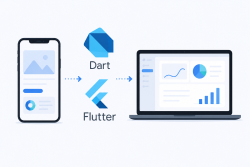
Flutter is Google’s open-source UI framework, and Dart is the programming language it’s built on. Together, they let you write your app once and deploy it to iOS, Android, web, and desktop from a single codebase.
That single codebase is the real source of the savings. One development team. One QA cycle. One bug fix that resolves everywhere instead of twice. Flutter’s hot reload feature also lets developers see changes instantly, and teams typically ship 25–35% faster than with native development — which directly lowers labor cost, the single biggest line item in any Flutter app development cost estimate.
What the Numbers Actually Look Like in 2026?
It helps to look past the hype and at real figures.
| Metric | 2026 Industry Average |
|---|---|
| Cost savings vs. native (standard apps) | 30–40% |
| Cost savings vs. native (hardware-heavy apps) | 10–15% |
| Maintenance cost reduction | ~40% |
| Development speed increase | 25–35% faster |
| Typical MVP Cost | $15,000 – $30,000 |
| Typical Business App Cost | $30,000 – $80,000 |
| Enterprise-grade App Cost | $150,000+ |
Maintenance costs drop by roughly 40% compared to maintaining two native apps, since updates and bug fixes roll out across both platforms simultaneously rather than twice over — and this is where a large share of the long-term savings actually show up, well after launch.
This isn’t experimental territory either. Companies like BMW, Google Pay, Nubank, and Toyota run Flutter in production, serving tens of millions of users. If it scales for them, it scales for a startup building its first product.
Where Cross-Platform App Development Helps Startups Specifically?
The advantages of cross-platform app development go beyond cost savings — speed and flexibility matter just as much for an early-stage company.
1. Faster time to market. A shared codebase means you can launch on both app stores simultaneously instead of staggering releases, which matters when you’re racing to validate an idea before your runway runs out.
2. Smaller, leaner teams. You don’t need separate Swift and Kotlin specialists. One Flutter team handles both platforms, simplifying hiring and keeping communication tighter — another reason cross-platform app development consistently costs less than maintaining parallel native teams.
3. Easier iteration post-launch. Startups rarely get the product right on the first try. Updating one codebase is significantly faster than coordinating changes across two.
4. Lower long-term maintenance. This is where a large share of the real savings accumulates over time, not just in the initial build.
Flutter vs Native App Development: When Does Native Still Make Sense?
Flutter isn’t right for every project, and a good development partner should tell you that upfront.
If your app needs deep, platform-specific hardware access — think HealthKit integrations, Bluetooth Low Energy peripherals, or custom AR hardware — the gap in Flutter vs native app development narrows considerably, and native may genuinely be worth the extra investment. The same applies to performance-critical use cases like high-end 3D gaming.
For the vast majority of startup use cases — eCommerce apps, booking platforms, SaaS dashboards, fintech tools, content apps — Flutter delivers near-native performance without the doubled cost. Comparing Flutter vs native app development honestly, before committing to either, is the single best way to avoid an expensive mid-project pivot.
What to Keep in Mind Before You Start Building?
A few decisions separate a smooth Flutter build from a budget blowout:
1. Define your scope before writing any code. Vague requirements lead to vague quotes, and feature creep mid-development is a common reason budgets spiral.
2. Start with an MVP. Build the core experience, launch, gather real feedback, and let actual usage guide what gets built next.
3. Choose your backend carefully. Managed backends like Firebase work well early on and keep setup costs low. You can migrate to a custom backend later once your product proves it needs the scale.
4. Budget for maintenance from day one. Annual maintenance typically runs 15–20% of your initial build cost. Founders who don’t plan for this are often caught off guard a year in.
5. Work with a team that’s done this before. The framework matters less than the team building with it. Experienced developers avoid the architectural mistakes that turn a $30,000 project into a $60,000 one — which is ultimately what determines your real Flutter app development cost, not the framework itself.
How Sofrik Can Help?
At Sofrik, we’ve built our app development process around what startups actually need: speed, cost-efficiency, and a product genuinely ready to scale once it gains traction. 
Rather than throwing a generic team at every project, we start with a discovery phase to properly scope your app, recommend the right backend for your stage, and build using Dart and Flutter to keep your costs predictable from day one. We’ve shipped cross-platform apps across fintech, eCommerce, and SaaS, and know exactly where startups tend to overspend — and how to avoid it.
If you’re trying to figure out what your app idea would actually cost to build, that’s a conversation worth having before you write a single line of code.
Final Thoughts
The case for Dart and Flutter isn’t just about cutting costs for the sake of it — it’s about giving startups the speed and flexibility to compete with companies that have far bigger budgets. A 30–40% reduction in Flutter app development cost, combined with faster time to market and lower long-term maintenance, can be the difference between a startup that ships and iterates quickly, and one that runs out of runway before it ever gets real user feedback.
If you’re weighing your options for your next build, it’s worth having a proper conversation about scope, architecture, and what your specific product actually needs — before committing your budget to any single approach.
Get a free Flutter cost estimate from Sofrik — talk to our team today.
How long does it take to build a Flutter app?
Simple apps typically take 4–8 weeks, while more complex products with custom backends and integrations can take 3–6 months, depending on scope.
Is Flutter good enough for a serious, scalable product, or just MVPs?
Flutter is used in production by major companies serving millions of users, so it scales well beyond MVP stage when architected properly.
What's the biggest mistake startups make that drives up Flutter app development cost?
Skipping the discovery and scoping phase. Unclear requirements are the single most common reason Flutter projects go over budget.