hello@sofrik.com
AI Solutions for Small Businesses: A Practical Guide to AI Automation, Chatbots & AI Agents

sofrik
13 August 2026


Running a small business often means wearing too many hats. You are answering customers, following up with leads, managing operations, creating content, checking reports, and still trying to grow the business.
This is where AI solutions for small businesses can make a real difference.
And no, you don’t need a huge technology budget or a team of AI engineers to get started. The right AI solution can take a repetitive task off your plate, help customers get answers faster, or connect different parts of your business into a smoother workflow.
The key is choosing AI based on a real business problem, not simply adopting AI because everyone else is talking about it.
What Are AI Solutions for Small Businesses?
AI solutions for small businesses are technologies that use artificial intelligence to help with tasks such as customer support, sales, marketing, data analysis, content creation, scheduling, and business operations.
These solutions can be as simple as an AI chatbot for small business websites or as advanced as AI agents that complete multi-step workflows.
For example, imagine a customer submits an inquiry on your website. Instead of waiting for someone to respond, an AI system can: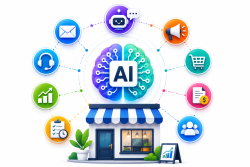
- Understand the customer’s question.
- Collect relevant information.
- Qualify the lead.
- Send the information to your CRM.
- Notify your sales team.
- Trigger a follow-up.
That is where AI moves beyond answering questions and starts becoming part of your business process.
Why Is AI for Small Business Becoming So Important?
Small businesses usually have fewer people and fewer hours to work with. That makes efficiency particularly valuable.
Current guidance from the U.S. Small Business Administration recommends that small businesses start with manageable AI use cases, test whether they create value, and consider both the benefits and risks before expanding adoption.
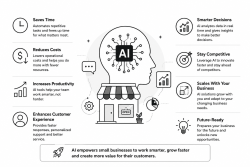
In practical terms, AI for small business can help you:
- Reduce repetitive administrative work
- Respond to customers faster
- Capture and qualify leads
- Personalize customer communication
- Analyze business information
- Automate routine workflows
- Give employees more time for higher-value work
Google also highlights applications such as organizing information, analyzing business performance and creating content as ways AI can help small businesses work more efficiently.
The goal isn’t to replace your team. It is to help a small team accomplish more without constantly adding manual work.
Where Can AI Automation for Small Business Help?
The best AI automation for small business starts with repetitive processes.
Think about the tasks your team performs every day or every week. If a process follows a predictable pattern, it may be a good candidate for automation.
Customer Support
An AI chatbot can answer common questions about products, services, pricing, availability, policies and operating hours.
More importantly, the chatbot can identify when a question requires a human and hand it over instead of continuing with an uncertain answer.
Lead Management
Instead of letting website inquiries sit in an inbox, AI can capture information, classify leads and send qualified prospects to your sales team.
This can be especially useful for service businesses where responding quickly can influence whether a prospect books a consultation.
Marketing
AI can help teams research topics, draft content, summarize customer feedback, personalize communication and organize marketing workflows.
You still need human review, particularly for brand messaging and factual claims, but AI can reduce the amount of repetitive preparation.
Internal Operations
AI workflow automation can connect forms, email, CRM systems, spreadsheets and other business applications.
For example:
New inquiry → AI qualification → CRM update → sales notification → follow-up
That is a much more useful application of AI than simply giving employees another chatbot to use.
AI Chatbots vs. AI Agents vs. Automation: What’s the Difference?
| Automation | AI Chatbot | AI Agent |
|---|---|---|
| ⚙️ Rule-based | 💬 Conversational | 🤖 Goal-driven |
| Follows predefined rules | Understands user questions | Plans and takes actions |
| Repetitive tasks | Customer conversations | Multi-step workflows |
| Limited decision-making | Responds to requests | Can make decisions within defined boundaries |
| Example: Email workflow | Example: Support chatbot | Example: Lead qualification + CRM update |
Turning the Differences Into Practical Business Solutions!
AI Chatbot
An AI chatbot for small business primarily communicates with customers or employees.
It can answer questions, provide information and guide users through predefined processes.
Best for: FAQs, customer support, lead capture and basic assistance.
AI Automation
AI automation connects tasks and systems so that work happens with less manual intervention.
Best for: repetitive workflows, notifications, data entry, follow-ups and process coordination.
AI Agent
AI agents for small business go a step further. An agent can interpret a goal, decide what actions are required, use connected tools and complete multiple steps.
For example, an AI sales agent might receive a lead, research relevant information, prepare a personalized response and update the CRM.
However, agentic AI should not mean giving an AI unlimited control. Recent research on AI for small and medium-sized companies emphasizes controlled autonomy, integration, governance and human accountability rather than simply pursuing full automation.
When Should You Consider Custom AI Solutions?
Off-the-shelf AI tools for small business are a great starting point. You can use them for writing, research, customer communication, analysis and other everyday tasks.
But eventually, you may find that generic tools don’t understand your specific processes.
That’s when custom AI solutions can make sense.
For example, your business might need an AI system that connects:
Website + CRM + customer database + internal documents + support system
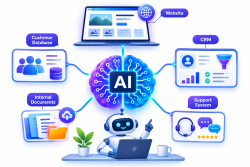
A customized solution can be designed around those systems and your actual workflow instead of forcing your business to adapt to a generic tool.
This is also where an experienced technology partner can help.
At Sofrik, AI-powered solutions include chatbots, generative AI, voice assistance and task automation, with solutions designed around business processes and customer experiences.
If your business needs something beyond a standard AI tool, you can explore Sofrik’s AI-powered solutions to see how custom AI can fit into your operations.
How to Choose the Right Small Business AI Solutions?
Before purchasing an AI platform, ask yourself five simple questions:
1. What problem am I solving?
Don’t start with “Where can I use AI?” Start with “What is slowing my business down?”
2. How frequently does the task happen?
Automating a task performed 50 times a day can create considerably more value than automating something done once a month.
3. Does the task require human judgment?
If yes, consider an AI-assisted workflow with human approval rather than full automation.
4. What information will the AI access?
Understand what customer, financial or business data is being processed and what security controls are available.
5. How will I measure success?
Track time saved, response time, lead conversion, support volume, error rates or operating costs.
This approach prevents you from collecting dozens of disconnected AI tools that your employees barely use.
A Practical AI Implementation Roadmap
You don’t need to transform your entire business overnight.
Step 1: Find One Bottleneck
Choose one repetitive problem. For example, slow lead follow-up.
Step 2: Start Small
Test an AI tool or workflow with a limited group of users.
Step 3: Keep Humans in the Loop
Review important AI-generated responses and decisions before giving the system more autonomy.
Step 4: Connect Your Existing Systems
Once the workflow works, integrate it with your CRM, website, email or other business software.
Step 5: Measure the Result
Compare the process before and after implementation.
Step 6: Expand What Works
If the first use case creates measurable value, move to the next bottleneck.
This gradual approach is important because AI adoption is not simply about adding technology. Recent SMB research points to workflow redesign, integration, security and employee enablement as important factors in turning AI experiments into lasting business value.
What Should Small Businesses Watch Out For?
AI can be incredibly useful, but it isn’t automatically accurate.
AI systems can produce incorrect information, misunderstand customer requests or make inappropriate recommendations. That’s why businesses should establish clear review processes for important decisions.
You should also consider:
- Customer data privacy
- Access permissions
- Security
- AI accuracy
- Human oversight
- Employee training
- Integration with existing systems
- Ongoing maintenance
The objective is not to automate everything. It is to automate the right things safely.
How Sofrik Can Help With AI Solutions for Small Businesses?
If you’re unsure whether you need a chatbot, automation workflow, AI agent or a completely custom application, starting with your business process is usually the best approach.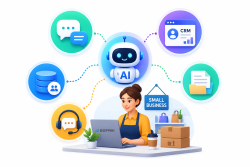
Sofrik works across AI-powered solutions, custom software, web and app development, and enterprise platforms. Its AI capabilities include chatbots, generative AI, voice assistance and task automation.
That means a small business can start with one focused use case and build toward a larger AI ecosystem as its needs grow.
For businesses that need a technology solution built around their specific workflow, Sofrik’s custom web and app development services can also support integrations and tailored digital platforms.
Final Thoughts
The best AI solutions for small businesses aren’t necessarily the most complicated ones.
Sometimes, the biggest improvement comes from a simple chatbot that answers customers 24/7. Sometimes it’s an automated lead follow-up. For another business, an AI agent connected to the CRM may be the better option.
The important thing is to start with a real bottleneck, test the solution, measure the outcome and expand only when it works.
AI is becoming easier for small businesses to adopt, but the businesses that benefit most will be the ones that treat it as a business strategy rather than just another technology trend.
If you’re exploring AI solutions for small businesses, start with one question:
“What repetitive task would I love to stop doing manually?”
That’s often the best place to begin.