hello@sofrik.com

Why Your Car Rental Business Is Losing Bookings (And How Software Fixes It)

sofrik
27 July 2026


Somewhere in your business right now, a customer is trying to book a car — and failing. Maybe they called during your lunch break and nobody picked up. Maybe they filled out a form on your website and never heard back. Maybe they showed up at the counter for a car that was, on paper, “available,” except it wasn’t, because someone else booked it an hour earlier through WhatsApp.
None of these are one-off accidents. They’re symptoms of a much bigger, very common problem: a car rental business losing bookings because of how reservations are being managed, not because of pricing or competition. This article breaks down exactly where those lost bookings are coming from, what they’re actually costing you, and what a real fix looks like.
Reasons Your Car Rental Business Losing Bookings| The Real Breakdown
Most owners assume lost customers mean lost interest — someone found a cheaper deal elsewhere. In reality, when you dig into the operational side of rental businesses, the pattern is almost always the same: the business never actually lost the customer’s interest. It lost the booking itself, somewhere in the process, before the customer ever got a confirmation.
Here’s what that looks like in practice, and why each one happens.
1. Double Booking in Car Rental Fleets — The Silent Revenue Killer
Double booking in car rental operations happens when the same vehicle gets confirmed to two different customers for overlapping dates. It’s rarely intentional — it happens because availability is being tracked in more than one place at once: a paper logbook at the counter, a shared Excel sheet, a WhatsApp group with the ops team, and a Google Calendar nobody updates consistently.
Here’s the actual sequence that plays out in most rental shops:
- Customer A books a car by phone on Monday. Staff member writes it in the logbook.
- Customer B books the same car online on Tuesday, because the website’s calendar was never synced with the logbook.
- Both bookings get confirmed. Nobody notices until pickup day.
- One customer is turned away — often the one who booked first and trusted you most.
The financial hit isn’t just the one rental you lose. It’s the refund or compensation you may owe, the staff time spent scrambling to find a replacement vehicle, and — the most expensive part — the customer who now leaves a public review warning others not to book with you. Industry data on service businesses consistently shows that a single bad review can influence dozens of potential customers before they even contact you.
2. Missed Rental Bookings From Slow or Fragmented Response Times
Missed rental bookings usually aren’t “missed” because the customer didn’t want to rent from you. They’re missed because your response came too late. If inquiries arrive through five different channels — Instagram DMs, a contact form, a phone line, walk-ins, a booking widget — and there’s no single place where your team can see and respond to all of them, some will inevitably sit untouched for hours.
In a market where a customer can open three rental apps and compare instant quotes in under two minutes, a delayed reply doesn’t just risk losing the booking — it almost guarantees it. Speed of response has become as important as price in this industry.
3. Weak Booking Management for Car Rentals Creates a Domino Effect
Booking management for car rentals covers more than taking the reservation. It includes updating availability the second a car is booked, tracking when it’s due back, flagging maintenance windows, and making sure the next customer isn’t accidentally offered a car that’s still out.
When car rental booking management relies on manual updates, one missed step cascades into the next. A return that isn’t logged on time blocks the next booking. A maintenance schedule that isn’t checked against reservations results in a customer showing up to a car that’s at the service center. Each of these individually seems small — but together, they erode customer trust fast.
4. Manual Booking Errors Compound as You Scale
A single manual booking error — a wrong date, a mismatched car model, a duplicate entry — might cost you one bad experience. But manual booking errors don’t stay isolated; they multiply as your fleet and booking volume grow. A process that “just about works” with 10 cars and a handful of daily bookings usually breaks down completely at 30+ cars and multiple staff members handling reservations independently. What felt like manageable chaos becomes a pattern of recurring mistakes that customers notice.
5. No Centralized Car Rental Scheduling Software
Without proper car rental scheduling software, your fleet’s real-time status lives in someone’s memory, or across disconnected spreadsheets that don’t talk to each other. That makes it nearly impossible to answer a simple question quickly: “Which cars are free this weekend?” If your own team struggles to answer that in seconds, your customers will feel the delay too.
How to Reduce Double Bookings: A Practical Step-by-Step Approach
If you’re specifically looking into how to reduce double bookings, here’s the sequence that actually works, based on how rental businesses successfully fix this:
- Centralize every booking channel into one calendar. Whether a reservation comes from your website, a phone call, or a walk-in, it needs to land in the same system in real time — not get transcribed later.
- Make availability update instantly. The moment a car is booked, it should be marked unavailable everywhere it’s listed, with zero manual re-entry.
- Build in maintenance and buffer time automatically. A returned car shouldn’t be bookable again until it’s been checked, cleaned, and cleared — your system should enforce that, not rely on someone remembering.
- Give every staff member the same live view. If your counter staff, phone staff, and online booking system are looking at different versions of “availability,” conflicts are inevitable.
- Automate confirmations and reminders. Both your team and the customer should get instant, automatic confirmation the moment a booking is locked in — removing the ambiguity that leads to double-booked slots.
This is, in essence, how car rental software improves bookings — not through a single feature, but by removing every manual handoff where human error can creep in.
Manual Process vs. Car Rental Software: What Actually Changes
| Task | Manual Process | With Car Rental Software |
|---|---|---|
| Checking vehicle availability | Cross-checking spreadsheets, logbooks, and chats | Instant, real-time view across all channels |
| Confirming a booking | Manual entry, prone to duplication | Automatic, conflict-checked confirmation |
| Handling multiple channels | Staff manually consolidates inquiries | All channels sync into one dashboard |
| Tracking returns and maintenance | Relies on memory or paper logs | Automatically blocks re-booking until cleared |
| Customer communication | Manual follow-ups, easy to forget | Automated confirmations and reminders |
| Reporting on performance | Manual spreadsheet calculations | Built-in dashboards and analytics |
The pattern is consistent: everywhere a manual step exists, there’s a point of failure. Everywhere software replaces it, that failure point disappears.
Common Car Rental Business Mistakes That Quietly Cost You Bookings
Beyond the booking process itself, a few recurring habits tend to hold rental businesses back as they try to scale:
- Outgrowing spreadsheets without switching systems. What worked at 5 cars doesn’t work at 50, but many businesses delay switching until after a costly mistake forces the issue.
- Treating booking confirmation as optional. Customers who don’t get an immediate, clear confirmation often assume the booking didn’t go through — and book elsewhere as a backup, sometimes canceling on you last minute.
- No visibility into which vehicles or seasons actually drive revenue. Without reporting, it’s hard to know where to invest in fleet expansion or where you’re leaving money on the table.
- Delaying maintenance tracking until a car breaks down mid-rental. This creates both safety risk and a scheduling nightmare.
- Underestimating how much staff time manual processes consume. Hours spent reconciling bookings by hand are hours not spent on customer service or growth.
These common car rental business mistakes aren’t about effort — most rental business owners work incredibly hard. They’re about infrastructure that hasn’t kept pace with the business.
How Software Actually Fixes This?
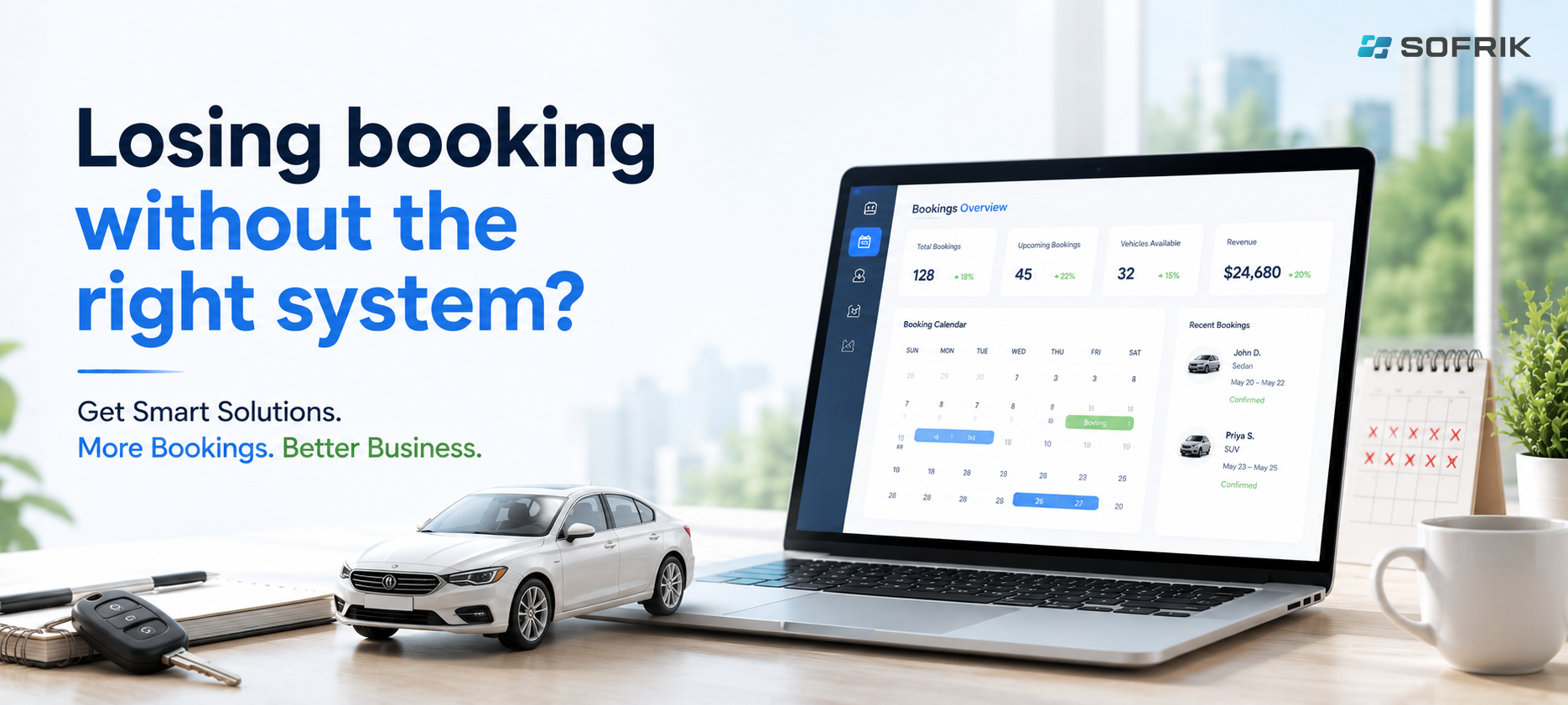
A dedicated car rental software platform is built specifically to close these gaps — it centralizes every booking channel into one real-time calendar, so two customers can never be confirmed for the same vehicle at the same time, and every reservation, cancellation, and return updates instantly across your entire team.
Beyond preventing conflicts, car rental management software handles the operational layer that manual processes struggle with — contracts, payments, driver documentation, insurance records, and vehicle condition reports — all tied to each booking automatically, so nothing depends on someone remembering to update a file.
If your bookings currently arrive scattered across calls, messages, and web forms, vehicle rental management software consolidates them into a single dashboard, giving your team one accurate view of what’s booked, what’s available, and what’s due back — directly eliminating the manual booking errors that come from juggling disconnected tools.
For the missed bookings that happen simply because your office is closed or your team is busy, online car rental software lets customers check live availability and complete a booking themselves, 24/7, without waiting on a callback.
And for the day-to-day operational load — inquiry to confirmation to pickup to return — car rental booking software manages the full lifecycle with automated reminders and confirmations, so nothing falls through the cracks even during your busiest weeks.
How to Increase Bookings for Your Car Rental Business?
Fixing the booking process doesn’t just stop losses — it becomes a growth engine. Once the operational chaos is under control, here’s where the real gains come from:
- Improve car rental bookings by removing friction — customers who can book instantly online convert at far higher rates than those who have to call and wait.
- Increase car rental reservations by responding to every inquiry within minutes instead of hours, closing the window competitors use to win the customer instead.
- Manage rental fleet efficiently with a live view of every vehicle’s location, condition, and availability, so you’re never guessing.
- Grow car rental business revenue by reducing no-shows and last-minute cancellations through automated confirmations and reminders.
- Strengthen car rental business management with centralized reporting that shows exactly which vehicles, locations, and seasons perform best.
- Invest in rental business automation so staff time shifts from fixing errors to serving customers and growing the business.
- Improve customer experience in car rental by making every step — search, booking, pickup, return — fast, transparent, and mistake-free.
The Bottom Line
Losing bookings is rarely one dramatic failure — it’s the slow accumulation of double bookings, missed inquiries, and manual errors that quietly compound month after month. The businesses that break out of this cycle are the ones that recognize the pattern early and rebuild their booking process around a system that’s designed to prevent it, rather than one that just tries to keep up.
If any of this sounds familiar, it’s worth taking a closer look at what a purpose-built car rental software platform could do for your operation — not as a quick patch, but as the foundation your business needs to actually grow with confidence.
When should I switch from manual booking management to car rental software?
If your team is spending too much time managing reservations, experiencing frequent booking mistakes, or finding it difficult to track vehicle availability, it's time to switch. Investing in car rental software early can improve efficiency, reduce operational costs, and support business growth.
Will car rental software work for a small rental business?
Absolutely. Modern car rental software is designed for businesses of all sizes. Whether you manage a handful of vehicles or a large fleet, it can automate daily operations, improve customer service, and help your business scale without adding unnecessary administrative work.
What features should I look for in car rental software to avoid losing bookings?
Look for features such as real-time vehicle availability, online booking, automated confirmations, fleet management, maintenance tracking, payment integration, customer management, and detailed reporting. These features help eliminate common booking issues and improve the overall rental experience.