hello@sofrik.com

Artificial Intelligence in Business: Approaches, Applications & Benefits

sofrik
2 September 2025


AI in business is changing how companies automate processes, analyze information, serve customers, and make decisions. From machine learning and predictive analytics to generative AI and intelligent automation, businesses can now use AI-powered solutions to solve specific operational problems and create more efficient workflows.
However, successful artificial intelligence in business is not simply about adding an AI tool. The real value comes from choosing the right use case, preparing reliable data, integrating AI with existing systems, and measuring whether the solution produces a meaningful business outcome.
This guide explains the major AI technologies for business, practical applications, benefits, implementation strategies, and the key considerations businesses should understand before investing in AI.
What Is AI in Business?
AI in business refers to using artificial intelligence technologies to perform tasks that traditionally require human intelligence, such as analyzing information, recognizing patterns, understanding language, making predictions, generating content, or supporting decisions.
IBM describes AI in business as the use of AI technologies to support areas such as customer service, marketing, operations, and decision-making.
Businesses can use AI to: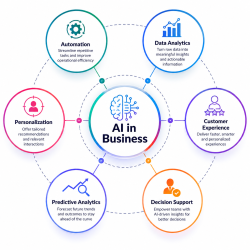
1. Automate repetitive tasks
2. Analyze large volumes of data
3. Personalize customer experiences
4. Predict demand and customer behavior
5. Detect unusual activity
6. Improve decision-making
7. Support employees with intelligent tools
8. Optimize business processes
The best AI projects start with a clear business problem rather than simply asking, “Where can we use AI?” For small and growing companies, starting with a focused use case can be especially practical. Our guide to AI solutions for small businesses explains how businesses can use AI automation, chatbots, and AI agents without starting with a large-scale transformation.
Key AI Technologies Used in Business
Different business problems require different technologies.
1. Machine Learning
Machine learning in business uses historical data to identify patterns and make predictions or classifications.
Common applications include customer churn prediction, fraud detection, demand forecasting, lead scoring, and predictive maintenance.
2. Natural Language Processing
Natural language processing (NLP) enables systems to understand and process human language. Businesses use NLP for chatbots, document processing, sentiment analysis, automated support, transcription, and information retrieval.
3. Computer Vision
Computer vision allows AI systems to analyze images and video. It can support quality inspection, inventory monitoring, document scanning, security applications, and automated visual analysis.
4. Generative AI
Generative AI can create text, images, code, summaries, and other content. Businesses are using it for content assistance, research, customer support, software development, document workflows, and internal knowledge tools. For customer-facing applications, AI chatbots can be a practical starting point for automating routine interactions.
5. Predictive Analytics
Predictive analytics uses historical and current data to estimate future outcomes. It can support sales forecasting, inventory planning, risk assessment, customer behavior analysis, and operational planning.
6. AI Agents and Intelligent Automation
AI agents can perform multiple steps within a workflow rather than simply responding to a single prompt. Businesses exploring this approach can also learn how autonomous agents can help startups compete and automate workflows.
AI Applications in Business
The best AI applications in business are usually connected to a measurable business need. Depending on the requirement, these applications may involve custom development, machine learning, automation, or integration with existing platforms. Businesses looking for custom AI development solutions can evaluate the technology based on their specific workflows and goals.
1. Customer Service
AI-powered chatbots and virtual assistants can answer common questions, provide information, collect customer details, and route complex issues to human representatives.
2. Marketing and Sales
AI can support customer segmentation, lead scoring, recommendations, campaign analysis, sales forecasting, and personalized communication.
3. Finance
Businesses can use AI for fraud detection, invoice processing, financial forecasting, expense analysis, and anomaly detection.
4. Retail and E-commerce
AI can help businesses personalize product recommendations, forecast demand, optimize inventory, analyze customer behavior, and improve online customer experiences.
5. Manufacturing
Manufacturers can use AI for predictive maintenance, quality inspection, production optimization, demand forecasting, and defect detection.
6. Human Resources
AI can assist with resume screening, employee onboarding, workforce analytics, internal support, and training recommendations.
7. Supply Chain and Logistics
AI can support demand forecasting, inventory planning, route optimization, supplier analysis, and delivery predictions.
8. Cybersecurity
AI can help identify unusual behavior, detect potential threats, prioritize security alerts, and support fraud and anomaly detection.
How to Choose the Right AI Use Case?
Not every business problem needs AI. Before investing, ask: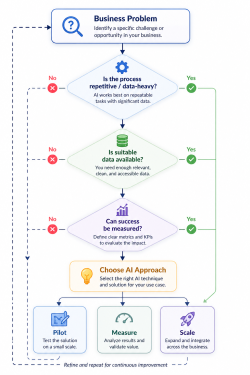
1. Is the process repetitive or time-consuming?
2. Does it involve large amounts of data?
3. Is there a clear business problem to solve?
4. Can success be measured?
5. Is the required data available and reliable?
6. Can the solution integrate with existing systems?
7. Is human oversight still required?
For example:
| Business Problem | Potential AI Solution |
|---|---|
| Repetitive customer questions | AI chatbot |
| Customer churn | Predictive machine learning |
| Manual document processing | AI document automation |
| Poor demand forecasting | Predictive analytics |
| Manual quality inspection | Computer vision |
| Repetitive workflows | AI-powered automation |
| Suspicious transactions | Anomaly detection |
Starting with a focused, measurable use case is generally more practical than attempting a company-wide AI transformation immediately. Current research also emphasizes clear business cases, operational readiness, and measurable outcomes as organizations move from experimentation toward scaled AI adoption.
Benefits of AI in Business
The benefits of AI in business depend on the use case, but common advantages include:
1. Increased Productivity
AI can reduce repetitive manual work and allow employees to spend more time on higher-value activities.
2. Faster Decision-Making
AI can analyze large datasets and surface patterns or predictions that help teams make better-informed decisions.
3. Improved Customer Experience
Personalization, recommendations, and AI-powered customer support can help businesses provide faster and more relevant interactions.
4. Operational Efficiency
AI can identify inefficiencies and automate parts of workflows, helping businesses improve speed and consistency.
5. Better Use of Data
AI can turn large amounts of structured and unstructured information into useful insights.
6. Scalability
Automated AI workflows can help businesses manage increasing volumes of customers, transactions, documents, or support requests.
How to Implement AI in Your Business?
A successful AI implementation for businesses should follow a practical process.
1. Identify the Problem
Start with a specific business challenge and define what improvement you want to achieve.
2. Check Data Readiness
Review the quality, availability, accessibility, and security of the data required for the AI solution. Data readiness is increasingly recognized as a critical foundation for scaling enterprise AI.
3. Select the Right Technology
Choose the technology based on the problem—not the other way around. The solution could involve machine learning, generative AI, NLP, computer vision, predictive analytics, or automation.
4. Build a Pilot
Test the solution on a focused use case before making a larger investment.
5. Integrate With Existing Systems
An AI solution may need to connect with your CRM, ERP, website, mobile application, databases, APIs, or internal business platforms. When AI becomes part of a customer-facing product, businesses may also need application development and integration expertise. Sofrik provides mobile app development services for businesses building AI-enabled mobile experiences.
6. Measure Results
Track measurable outcomes such as:
a. Processing time
b. Response time
c. Conversion rate
d. Error rate
e. Customer satisfaction
f. Employee productivity
g. Operating cost
h. Revenue impact
7. Scale What Works
Once the pilot demonstrates measurable value, improve the workflow and expand it to other relevant areas.
Build, Buy, or Customize an AI Solution?
Businesses generally have three options.
A. Buy an Existing AI Tool
Best when the business has a common requirement that can be solved with an existing product and requires limited customization.
B. Customize an Existing Solution
Useful when a standard AI platform provides most required capabilities but needs custom workflows, integrations, or business-specific features.
C. Build a Custom AI Solution
| BUY | CUSTOMIZE | BUILD |
|---|---|---|
| Existing tool | Existing platform + custom features | Fully custom solution |
| Faster setup | Flexible | Maximum control |
| Common requirements | Specific workflows | Unique requirements |
A custom solution may be more appropriate when the business has unique processes, proprietary data, complex integrations, or requirements that existing products cannot adequately address. In such cases, custom web and app development can also be relevant when AI needs to become part of a larger customer-facing or operational application.
The right choice depends on the problem, budget, data, security requirements, expected scale, and long-term business value.
AI Readiness Checklist
Before starting an AI project, businesses should evaluate:
a. Clear business objective
b. Defined use case
c. Reliable data
d. Data security and privacy
e. Existing system integrations
f. Technical infrastructure
g. Available expertise
h. Budget and expected ROI
i. Human oversight
j. Security and governance requirements
k. Measurable success criteria
This preparation can reduce the risk of investing in an AI project that works technically but fails to create meaningful business value.
How to Measure AI ROI?
AI should be evaluated as a business investment, not only as a technology project.
For example:
Customer service: measure response time, ticket volume, resolution rate, and customer satisfaction.
Sales: measure qualified leads, conversion rates, sales cycle length, and revenue.
Operations: measure processing time, labor hours, error rates, and operating costs.
AI cost: consider development, infrastructure, APIs or model usage, integration, maintenance, security, and employee training.
The goal is to connect AI spending with measurable business outcomes. Current 2026 research continues to highlight the difficulty many organizations face in proving AI ROI and the importance of linking AI initiatives to operational and financial results.
AI Security, Privacy, and Human Oversight
Businesses should consider security from the beginning of an AI project.
Important considerations include:
a. Protecting sensitive business and customer data
b. Controlling who can access AI systems
c. Monitoring AI outputs and actions
d. Preventing unauthorized data exposure
e. Maintaining appropriate human review
f. Creating clear AI usage policies
g. Reviewing third-party AI providers
h. Keeping audit and access records where appropriate
This becomes even more important when AI systems can take actions rather than simply generate information. Current research highlights governance and controls as areas that need to keep pace with increasingly autonomous AI systems.
What Should Businesses Automate With AI?
AI is particularly useful for tasks involving:
a. Repetitive processing
b. Pattern recognition
c. Data analysis
d. Classification
e. Summarization
f. Forecasting
g. Routine customer questions
h. Document processing
Human involvement should remain important for:
a. Strategic decisions
b. Sensitive customer situations
c. High-impact decisions
d. Complex judgment
e. Compliance-sensitive activities
f. Situations requiring empathy or contextual understanding
The strongest AI business solutions often combine automation with human expertise rather than attempting to remove people from every workflow.
AI Trends Businesses Should Watch in 2026
1. Agentic AI
AI is moving toward systems that can complete multi-step tasks and interact with business workflows.
2. AI-Powered Automation
Businesses are increasingly connecting AI with existing applications and workflows instead of using AI as a standalone tool.
3. Data-Ready AI
Reliable, accessible, governed data is becoming increasingly important as businesses move AI from experimentation into production.
4. AI Governance
Security, privacy, access controls, model oversight, and responsible AI practices are becoming more important as AI adoption expands.
5. Measurable AI ROI
Businesses are placing greater emphasis on proving whether AI investments actually improve revenue, productivity, cost, speed, or risk outcomes.
How Can Sofrik Help With AI Solutions for Business?
Choosing and implementing the right AI technology requires more than selecting an AI model. Businesses may need application development, system integration, automation, data workflows, infrastructure, security, and ongoing technical support. Sofrik provides artificial intelligence and machine learning services to help businesses develop and integrate AI-powered capabilities.
Sofrik can help businesses explore and develop AI solutions for business based on their specific requirements—from identifying suitable use cases to developing, integrating, and improving AI-powered applications.
The right approach is to start with a clear business problem, select the appropriate technology, build a focused solution, measure its impact, and scale what delivers real value.
Looking to explore an AI solution for your business? Connect with Sofrik to discuss your requirements.